
.webp)
Post Summary
The GM at location 7 starts every shift the same way.
He checks his phone before he even walks through the door. Not because he's diligent. Because he has to know what got missed on the previous shift before the lunch rush hits.
A cooler that wasn't logged. A closing task someone skipped. A maintenance issue that was mentioned out loud at handoff and then never written down. Gone.
By the time he's sorted it out, he's already 40 minutes into a shift that should have started clean.
This isn't a GM problem. It's a systems problem. At one location, a manager can see what's getting done. At ten or twenty locations, task management is essentially an honor system. And honor systems fall apart at scale.
This article walks through a practical framework for building a restaurant task management system that works across multiple locations. Not in theory. In the actual conditions of a busy service.
Quick self-check before you keep reading:
- Do you know which tasks were skipped on the last closing shift at each of your locations?
- Is every shift's task list standardized across all locations, or does each GM run their own version?
- Can you verify task completion without calling or texting a manager?
If you answered no to any of these, this is for you.
.webp)
Recommended Resources:
.svg)

Priced on per user or per location basis
Available on iOS, Android and Web


What is restaurant task management and why does it break at scale?
Restaurant task management is the system operators use to assign, communicate, verify, and document the recurring tasks that keep each location running safely and consistently. Every shift, every day, at every location.
It covers:
- Opening and closing duties
- Food safety checks and temperature logs
- Cleaning schedules
- Line checks
- Shift-to-shift handoffs
- Maintenance flags
- Compliance documentation
At one location, this works through presence. The operator is there. They can see what's done and what isn't. At ten or twenty locations, that stops being possible. Every location you add widens the gap between "task assigned" and "task verified."
Most operators try to close that gap in two ways. Neither works.
More group texts and WhatsApp messages. Creates noise. No accountability record. A message sent is not a task confirmed.
A spreadsheet. Works briefly. Collapses the moment the person maintaining it leaves, gets busy, or starts working from a slightly different version than everyone else.
One McDonald's franchisee owner with 20 locations put it plainly: "We don't have a good way of following up and confirming that those things have been done." That's not a technology problem. It's a systems problem dressed up as a communication problem.
**
What an honor system looks like, What a task management system looks like
Tasks assigned verbally or by text, Tasks assigned by role and shift in a standardized template
Completion confirmed by saying "yeah", Completion verified with a time stamp and photo
No record of what was missed, Missed tasks flagged automatically before shift ends
DM calls GM to check status, DM sees real-time status on a dashboard
Problems discovered at inspection, Problems caught the same shift they occur
**
How to structure restaurant task management by shift tier
A task management system isn't a single list. It's a tiered structure built around the natural rhythm of a restaurant shift.
Four tiers. Four distinct accountability windows.
Opening tier: pre-service
Start 45 to 90 minutes before service.
- GM or opener walkthrough: equipment checks, temperature verification, cleanliness standards, setup confirmation
- FOH: table setup, POS check, reservation confirmations, staff briefing on specials and 86 items
- BOH: mise en place, temperature logs, first line check, cooler and freezer verification
- All critical items signed off before doors open
This tier sets the standard for the entire shift. A manager who skips the opening walkthrough doesn't find problems until a guest does.
Service tier: during service
- Line check refreshes every two to three hours
- Temperature log updates for proteins, coolers, and hot-hold equipment
- Floor walkthroughs on a set schedule
- Incident documentation as it happens, not reconstructed at end of shift
Most task management systems have nothing in this tier. Tasks are either pre-service or post-service. What happens during service gets handled reactively.
Building scheduled check-ins into the service window is the difference between catching a temperature issue at 1pm and finding it during a health inspection.
Closing tier: post-service
- BOH: deep clean by station, equipment shutdown, cooler organization, final temperature log
- FOH: POS reconciliation, sidework sign-off, closing walkthrough, restroom check
- Manager: task completion sign-off, shift notes, prep for the opening team's briefing
The closing tier is where pencil whipping happens most. Tasks get checked off at the end of the shift regardless of whether they were completed. Without photo verification on critical items, a signed-off closing checklist proves very little.
Handoff tier: shift to shift
This is the most consistently broken tier in restaurant operations.
What didn't get done. What broke. What needs flagging for the next manager.
Most restaurants do this verbally. A two-minute conversation in the parking lot between an outgoing and incoming manager. If the outgoing manager forgets something, the incoming manager doesn't know to look for it. The task disappears.
A senior ops leader described what this looks like over time: "The operation is most dialed at that particular hour on that particular day. Then it degrades over the next six days and then it gets set back." The weekly reset only works if the daily handoff is documented. Without it, the degradation compounds quietly until someone notices.
What makes restaurant task management break down in practice
Task management doesn't fail because GMs are bad at their jobs. It fails because the system asks people to do things that systems should do.
Here's exactly where it breaks:
The verbal confirmation trap. "Did you do it?" "Yeah." This is not task management. It's hope management. No record, no verification, no way to know if the answer was accurate.
The clipboard that lies. Paper checklists get pre-filled, backdated, or checked off at end of shift regardless of what actually happened. This is pencil whipping. It's common, understandable under pressure, and it makes the checklist worthless as a compliance document.
The format inconsistency problem. One ops manager at a 36-store chain asked every location to send their task list. Every location had one. None were in the same format. None had the same frequencies. None assigned tasks to specific roles. Fifteen locations, fifteen different operating standards, one brand name.
The GM departure cliff. When a strong GM leaves, every informal system and undocumented workaround leaves with them. The next GM starts from scratch. Without a platform that holds the standard independent of who's managing, every GM transition resets the operation.
The missing corrective action. A manager notices a problem, mentions it verbally, moves on. Three weeks later, the same problem appears during a health inspection because it was never documented, assigned, or verified as resolved. "A lot of things are falling through the cracks," as one ops director at a 114-location chain put it. The cracks aren't random. They're structural.
**
Failure mode, What it looks like, Why it matters
Verbal confirmation, "Yeah I did it" with no record, No accountability when something goes wrong
Pencil whipping, Checklist signed off without tasks completed, Creates false compliance confidence
Format inconsistency, 15 locations-15 different task lists, Impossible to manage standards at scale
GM departure cliff, New GM inherits no documented system, Every leadership change resets the operation
Missing corrective action, Problem noted verbally-never resolved, Same issues repeat across inspections
**
How to drive task compliance across multiple locations without being there
Compliance without presence requires visibility. Not more phone calls. Not more texts. Infrastructure that tells you what happened without you having to ask.
Four things that actually work:
1. Standardized templates, not manager-created lists.
The ops team sets the task standard. Every location runs the same template. GMs can add location-specific items but cannot remove required ones. This is the foundation. Everything else depends on it.
2. Required evidence, not honor systems.
Any critical task, temperature log, cooler verification, closing clean, ice machine check, requires a photo or logged measurement before it closes. No photo means the task is not verified. This one change eliminates pencil whipping on the tasks that matter most.
3. Real-time completion dashboards.
District managers shouldn't need to call GMs to find out what happened at location 9 last night. One owner we spoke with built his own version of this using Replit and an AI tool, pulling messages from 40 separate Google Chat channels into one dashboard. He built it himself because nothing else gave him what he needed. A proper task dashboard replaces that workaround with something that actually scales.
4. Escalation logic for missed tasks.
When a critical task goes unverified after its deadline, an alert fires to the GM, the DM, or both. Not on a weekly report nobody reads until Friday. Immediately. The shift is still happening. There's still time to fix it.
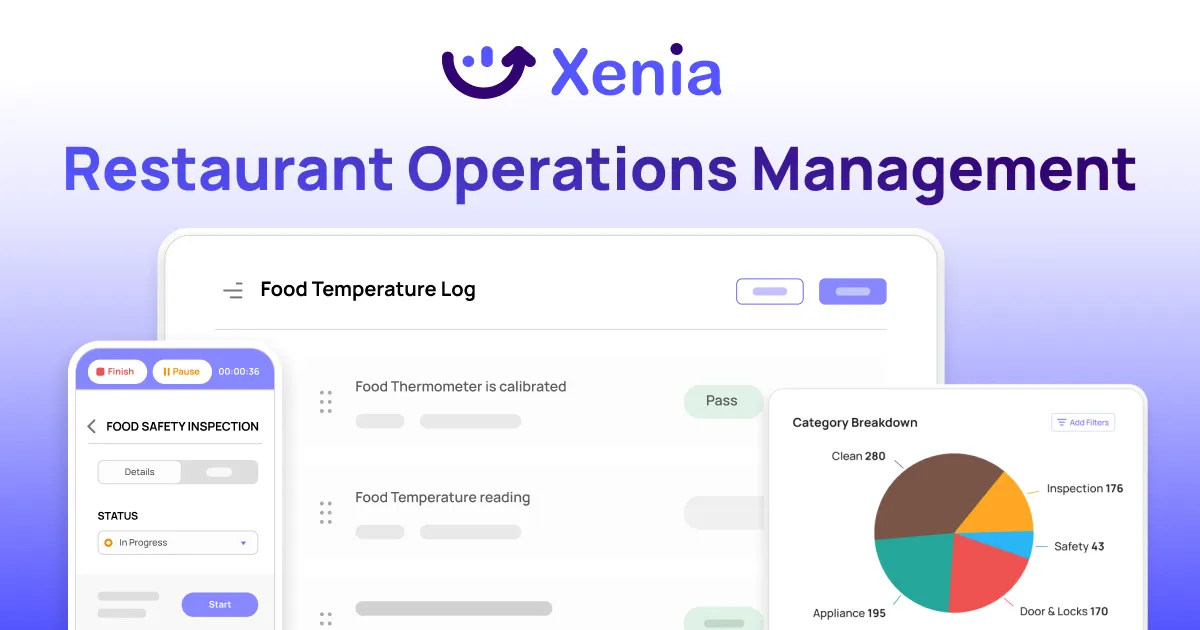
Xenia connects all 4 of these in one platform. Standardized shift templates, photo verification on critical tasks, a live dashboard by location, and automatic alerts when tasks go unverified. District managers get visibility without daily phone calls.
See how it works for multi-unit restaurants.
What makes restaurant task management harder than it should be
Even operators who understand the system run into friction. Here's where it shows up.
**
Challenge, What's happening, How to handle it
Frontline adoption, Staff abandon apps that are slow or complicated within two weeks, Mobile-first-simple interfaces with fast load times are non-negotiable
Over-tasking, 80-item shift checklists take longer than the actual tasks, Start with 10 critical items per tier-build from there
Multi-brand complexity, Different concepts need different task requirements, The platform needs to support multiple templates and location types
The "good enough" trap, Paper feels fine until an inspection or a GM leaves, The cost doesn't show on a Tuesday-it shows at the worst possible moment
**
The "good enough" trap is the one worth sitting with. "We do a ton of checklists, but they're half the time paper-based. We just have not made that really electronic at this point." That's from an operations contact at a full-service restaurant group.
The cost of good enough doesn't show up on a quiet Tuesday. It shows up during a health inspection, when a GM leaves, or when a franchise parent asks why three locations failed the same audit item for the third consecutive quarter.
Conclusion
Restaurant task management is a system, not a list.
The gap between "assigned" and "verified" is where compliance lives or dies. A task on a clipboard nobody checked isn't a completed task. A shift handoff that happened in a parking lot conversation and was then forgotten isn't a handoff.
The four-tier framework gives every shift a clear structure that doesn't depend on which manager is on duty. Opening, service, closing, handoff. When every tier is documented and every missed task generates a flag, the operation stops quietly degrading between visits.
Operators who've moved off paper and verbal confirmation say the same thing every time. They didn't know how much was slipping until they could finally see it.
That visibility is the whole point.
Frequently Asked Questions
Got a question? Find our FAQs here. If your question hasn't been answered here, contact us.
How do you keep task standards consistent across locations?

One template, used everywhere. Ops sets the standard. GMs can add location-specific items but cannot remove required ones. Completion is documented, not assumed.
A district manager should be able to see task status across every location from a single dashboard without making a single call.
How many tasks should be on a shift checklist?
Start with ten critical items per shift tier. A checklist with 45 items gets skipped when a cook calls out at 6am. A checklist with ten critical items gets completed. Build from there once adoption is solid.
What is pencil whipping?
It's when a checklist gets signed off without the tasks actually being completed. Someone checks every box at end of shift rather than as tasks are done.
It's common under pressure and makes the checklist useless as a compliance record. Photo verification on critical tasks is the most effective way to stop it.
What is shift handoff in a restaurant?
It's the transfer of critical information from an outgoing manager to the incoming one. What got done, what didn't, what broke, what needs attention. Most restaurants do this verbally. Anything the outgoing manager forgets doesn't get passed on. Documented handoffs close that gap.
Why does task management get harder as you add locations?
At one location, a manager can physically verify what's getting done. At ten or twenty, that's not possible. Every location added widens the gap between assigned and verified. Without a system that works without physical presence, task management defaults to an honor system. Honor systems fail at scale.


A Modern, AI-Powered Platform Built for Restaurant Operations
Xenia brings kitchen operations, food safety, audits, and team communication into one mobile-first platform. Restaurant teams execute daily work consistently, maintain compliance, and resolve issues faster, while leadership gets real-time visibility across all locations.
.webp)
Why Restaurant Operators Choose Xenia:
🤖 AI-Powered Operations, Convert paper logs instantly and verify food presentation and kitchen cleanliness automatically. Get instant answers about food safety trends without building reports.
🍽️ Food Safety & Compliance, Track line checks and temperature logs with automated alerts. Trigger corrective actions when readings exceed safe ranges. Maintain audit-ready records for health inspections.
📊 Multi-Location Control, Monitor food safety compliance and task completion across regions. Benchmark locations to identify training needs. Export reports for operational reviews.
One platform for kitchen operations, food safety, and compliance across all locations.

.svg)
.webp)
%201%20(1).webp)

.svg)
%201%20(2).webp)